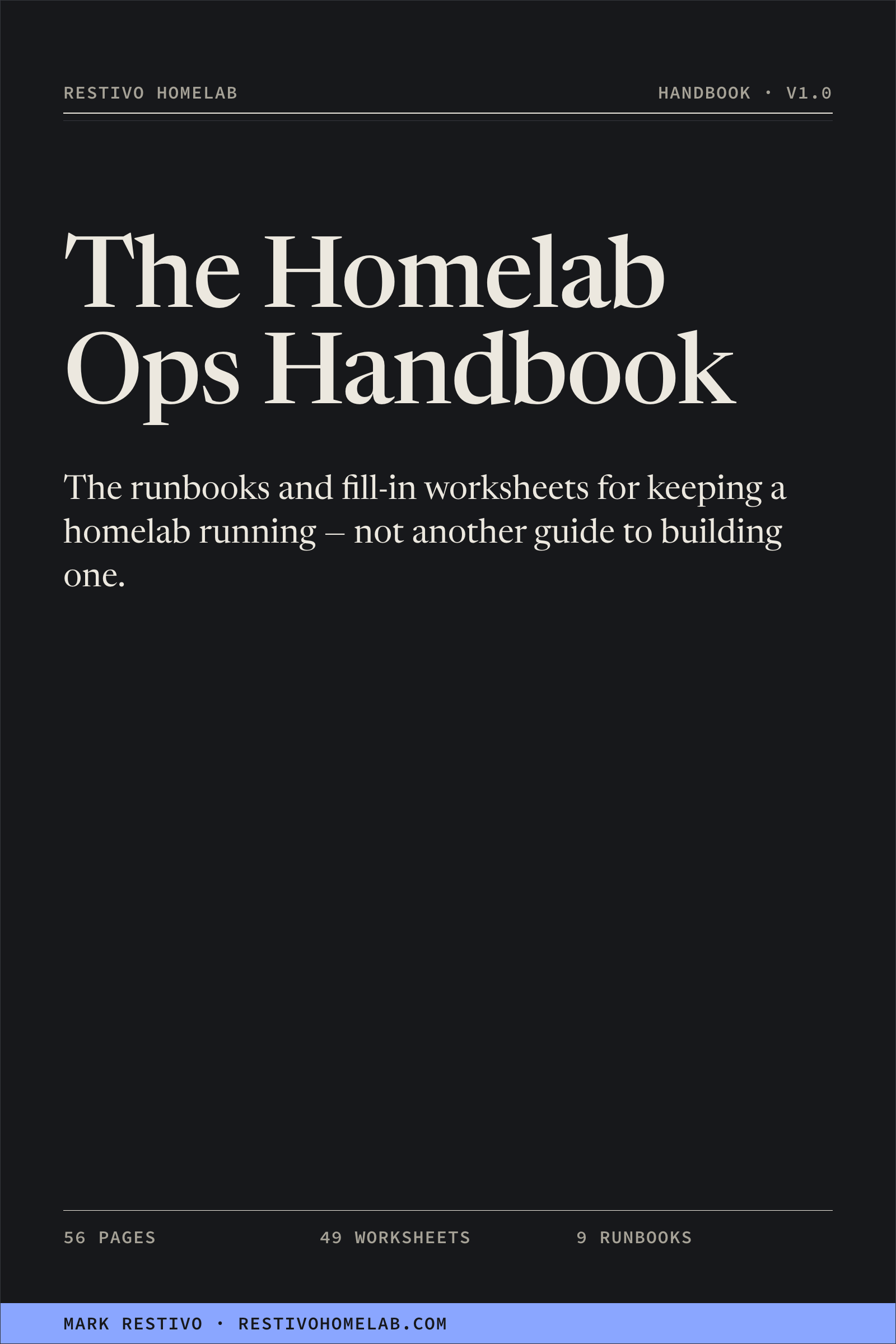
The Homelab Ops Handbook
The runbooks and fill-in worksheets for keeping a homelab running — not another
guide to building one.
$29 minimum, $39 suggested
Pay what you think it's worth, with $29 as the floor. Team licence (5 seats) $99.
Available September 15. Join the list to get it first.
Version 1.0, 56 pages, 49 worksheets and a 96-item checklist, updated
September 2026.
Free updates forever. 30-day 100% refund, no questions.
No subscription, no account, no DRM.
Your lab works. Then a disk dies, the ISP drops, or you have to restore a service you haven't
touched in eight months and can't remember how it was set up. This is the pack I use to avoid
that: nine runbooks and 49 worksheets covering the work that usually only gets written down
after something has already gone wrong.
After this you will be able to…
- Answer "what do I have, and what does it need" from one page. One inventory
of hosts, VMs, services and network segments — with a tier, a dependency and a
backed-up / monitored / public-facing flag on every row. Every other chapter reads from it
instead of re-deciding.
- Prove a backup restores, instead of assuming it. Restore to a scratch VMID
with the network disconnected, check a pass condition you wrote before you started, and
finish with a scorecard and an elapsed time — the number that turns "we have backups" into
"we can be back in about forty minutes."
- Say what breaks first and in what order you fix it. RTO and RPO per tier, a
recovery order-of-operations for your actual dependency chain, a minimum-viable-rebuild
checklist, and a grab-and-go off-site recovery kit.
- Decide what is worth waking you at 2 a.m. — and know the alert will arrive.
A baseline coverage table, alert-fatigue rules, and a notification-delivery test, so the
monitoring you trust is monitoring you have tested.
- Patch on a cadence and know what changed. A monthly patch window plan, a
CVE-just-landed fast path, a rollback decision log, and a change log that gives "what
changed right before this broke" a written answer.
Table of contents
- Asset & Service Inventory Worksheet — hardware, VMs and containers,
services, network segments, a credential pointer map, dependency chain, review cadence.
Read this chapter free
- Backup & Restore Drill Runbook — 3-2-1 worksheet, per-service backup
inventory, the drill itself, scorecard, drill log, future-me recovery note.
- Homelab Disaster Recovery Plan — failure scenarios, RTO/RPO by tier,
recovery order-of-operations, minimum viable rebuild, grab-and-go kit, handoff note.
- Monitoring & Alerting Baseline — baseline coverage table, notification
delivery, alert-fatigue rules, monthly review checklist and log.
- Patch & Update Management Runbook — update classification, cadence by
layer, before-you-touch-anything, update procedure, rollback decision, emergency fast path,
monthly patch log.
- Access & Credential Hygiene — credential inventory, MFA coverage, SSH key
hygiene, service-account and API-key sprawl, revocation checklist, quarterly access review log.
- Storage Pool Health — health-check table, capacity thresholds, SMART and pool
triage, disk replacement log.
- Network Outage — ISP, router/gateway, DNS and VPN failures as decision trees,
plus an ISP escalation call script and a fallback access plan.
- Changelog & Incident Log — why two logs and not one, severity
classification, change log, incident log, monthly pattern review.
Appendix A. The Homelab Ops Calendar — weekly, monthly, quarterly, annual and
always-on, plus a first-30-days plan.
Every chapter has the same shape: a when-to-open trigger list, a severity quick-set, the
worksheet or drill itself, and a scorecard so you can tell whether you're doing the thing or just
meaning to.
Who this is for
- The homelabber whose lab got serious. It now holds family photos, a friend's
service, or your own work — and losing it stopped being an inconvenience.
- The sysadmin who wants their own runbook library. Procedures you keep across
jobs, in your own notes and your own git repo, not in an employer's wiki.
- The one-to-three-person IT team. No ops documentation, no time to write it
from scratch, and no appetite for a compliance framework built for 500 people.
It is not a build guide. If you're still choosing a hypervisor, this isn't the thing to
buy yet.
What's in the download
- PDF — 56 pages, print-ready.
- EPUB — for a reader or the couch.
- Markdown — the whole handbook as one editable file for your wiki or repo.
- 49 worksheets — one Markdown file each, with
- [ ] checkboxes that
tick in Obsidian, GitHub, VS Code or any editor.
- 96-item checklist — every checkable item in the book, collected.
- Bonus: the Worksheet Pack — those 49 worksheets also delivered as a standalone
set, so you can drop them into your own docs without carrying the book.
One zip. No app, no account, no DRM, nothing that stops working if this site does.
FAQ
Do you do refunds?
Yes — 30 days, 100%, no questions asked. Email me and I'll refund it. You keep the files. I'd
rather you not be annoyed than hold $29.
Do I pay again for updates?
No. Free updates forever. The same download link always serves the newest version, and you get an
email when one ships.
What formats do I get?
A single zip with the PDF, EPUB, the full handbook as one Markdown file, and the 49 individual
Markdown worksheets. Everything is plain text or a standard document format.
Do I need Proxmox?
No. Proxmox, TrueNAS, ZFS, restic and Uptime Kuma show up as worked examples because naming a real
tool beats a placeholder, but every procedure works with whatever you actually run.
Was AI used to write this?
Honest answer: the procedures are the ones I run in my own lab — the inventory, the restore drill,
the patch cadence, the change log are what I actually do, and the worked examples are my own kit. I
used AI as an editor to tighten the prose and keep the nine chapters in one consistent shape. It did
not invent the procedures, and nothing in here is a summary of other people's blog posts.
Are there reviews?
Not yet — it hasn't shipped. I'd rather show none than invent them. The first buyers get asked for
a one-line review, and those go here when they exist.
Buy the handbook
Not ready to buy? Read a full chapter free,
or take the 96-item Homelab Ops Checklist — it's the short version of every
drill in the book, and it costs nothing.
Made by a working sysadmin who runs this lab. About Mark Restivo.